


You did it. After hours of scrolling through photos, watching videos, and gathering information — you’ve signed up for a kitesurfing course. The decision is made. Soon, you’ll be at the spot, facing your first encounter with a kite. Questions are swirling in your mind: Can I do this? What should I bring? What will the lessons be like?
In this article, you’ll find a practical guide to help you prepare for your first day of the course — so you’ll feel confident and know what to expect.
Before you hit the water — how to prepare for your kitesurfing course?
Before feeling the wind in your kite and the salty water on your face, it’s worth taking care of a few basic things. These may seem like small details, but they make a big difference — especially if you want to make the most of your time on the water. Below is a list of the most important tips to help you step into the world of kitesurfing without any surprises — step by step.
Gradually spreading the passion for the wind
What to bring to a kitesurfing course? — a practical checklist
At a kitesurfing course, all the essential equipment is provided on-site. The kite, bar, board, harness, wetsuit, and helmet — all supplied by a professional kitesurfing school. You only need to take care of a few personal items that will greatly affect your comfort during a windy day at the spot.
- A sporty swimsuit or swim trunks — ideally something you can comfortably wear under a wetsuit or a sun-protective rash guard.
- Microfiber towel — lightweight, quick-drying, and compact.
- High SPF sunscreen (SPF 50) — the sun in Sicily is very intense, and it reflects off the water, so proper skin protection is essential. Sun sticks are also a great addition — easy to apply, especially on the face and sensitive areas, effectively blocking harmful UV rays.
- Sunglasses — choose models with a flexible strap or cord to keep them from getting lost in the water. They’re an essential item for sunny days at Lo Stagnone.
- Headwear — a cap or hat comes in handy, especially during theory lessons on the beach when the sun is strong.
- Water bottle — staying hydrated is essential, as you’ll be in constant motion.
- Dry clothes to change into — after a few hours on the water, it’s good to have something dry to put on, like a light sweatshirt or a sports t-shirt, ensuring comfort after the lesson, even on a sunny, warm day.
- Energy snacks — a banana, an energy bar, or a handful of nuts are a quick way to recharge between lessons. At our base in Lo Stagnone, you can also count on access to simple snacks and drinks to help you regain strength before your next water session.
Learning kitesurfing with a smile on your face
Your first day on the course — theory, practice, and your first glides
Your first day on a kitesurfing course in Sicily is an exciting journey from theory to practice. Forget boring lectures — you’ll get a solid dose of knowledge presented in an accessible way, right at the spot. At the start, your instructor will explain:
- The characteristics of the Lo Stagnone Lagoon
- The most common wind directions and what they mean for your kitesurfing lessons
- What the “wind window” is and how it affects kite control
- The construction of all the equipment, its functions, and how it works
- Water safety rules and emergency safety systems
You’ll start your first exercises on land with a training kite, but very quickly you’ll move to working on the water. Under your instructor’s supervision, you’ll learn to control a small inflatable kite, launch it, and land it in the water. You’ll feel its power and understand how it responds in the wind window to your movements on the bar.
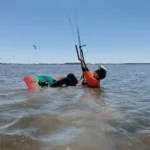
Once you’ve mastered the basics of kite control, you’ll move on to body drags — controlled movement through the water with the kite, but without the board. This is a key stage that helps you get comfortable with generating power and moving using the wind’s force.
All of these elements are part of Level 1 in the PZKite system — your first official step toward independent kitesurfing.
Master the solid fundamentals
During a kitesurfing course at our KITE HABITS school in Sicily, the instructor is not just a teacher — they are your guide, safety support, and motivator all in one. Their main task is to ensure your safety, but it’s equally important that you understand what you’re doing and why. They lead you step by step, observing the conditions on the water and adjusting the pace of learning to match your abilities.
At Lo Stagnone — where we teach on a shallow lagoon with predictable wind conditions — an experienced instructor knows every corner of the spot and how to plan your lesson most effectively. They monitor your progress, respond in real time, and support you at every stage.
Communication during lessons isn’t limited to gestures — on the water, you usually wear a helmet with a radio, allowing you to hear your instructor’s instructions even from several dozen meters away. You can also ask questions, request a maneuver to be repeated, or get a quick explanation — you’re guided in real time, without any guesswork.
Thanks to the instructor’s individual approach, calmness, and dedication, you’ll find it easier to get into the learning rhythm and feel more confident. A good instructor doesn’t just teach — they inspire a passion for kitesurfing.
Licensed instructors
Learning pace — engaged, but without pressure
Not everything has to go perfectly on the first day. In the beginning, you’ll make mistakes. Your kite will fall into the water dozens of times, you’ll probably swallow a bit of salty water, and experience more than one spectacular splash. This is a natural part of learning kitesurfing — not a reason to stress. Every kitesurfer, even the most experienced, has been through it.
The most important thing is to approach the classes with openness and focus. Don’t compare yourself to others – everyone learns at their own pace, with different experiences and physical abilities. Observe your progress and celebrate each step – each one brings you closer to swimming on your own.
Finally, the most important piece of advice: relax! Remember, a kitesurfing course is not an exam, but a way to spend an active holiday and have great fun. The key to success and enjoying the learning process is patience and a positive attitude. Laugh at your failures, celebrate the small victories, and soak up every moment spent on the water. Kitesurfing is all about freedom, joy, and connection with nature. Focus on these feelings, and progress will come on its own, faster than you think.
First kite lesson – this is where it all begins.
First kitesurfing course is an intense and rewarding adventure. It's worth preparing well for it to get the most out of it. If you have any questions before the lesson, feel free to contact us or check out how kitesurfing courses are organized at KITE HABITS. In our kitesurfing school, we make sure that every student feels taken care of from the first contact to the last day on the water.
See you at the spot – Lo Stagnone is waiting!